Roof Replacement Financing Options for Homeowners
Roof Replacement Financing Options for Homeowners

Roof replacement financing is defined as any financial product or payment plan that helps homeowners cover the cost of a new roof without paying the full amount upfront. The most common methods include cash, credit cards, home equity lines of credit (HELOCs), personal loans, deferred-interest offers, and contractor financing. The average roof replacement cost nationwide runs about $9,515, ranging from $5,867 to $13,212 depending on materials and roof size. That price tag makes financing not just convenient but necessary for most homeowners. Knowing which roof replacement financing options fit your credit profile, urgency, and home equity is the first step toward getting your roof replaced without financial stress.
What are the main roof replacement financing methods?
Homeowners pay for roofing projects using six primary methods, each with a different cost, speed, and qualification requirement. Choosing the right one depends on your credit score, how much equity you have in your home, and how fast you need the work done. Here is a clear breakdown of each option.
- Cash payment. Paying out of pocket avoids interest entirely. The downside is that draining savings for a roof can leave you exposed to other financial emergencies.
- Credit cards. Fast and accessible, but credit card APRs run 25%–35%, making them the most expensive long-term option. Use them only for smaller repairs or if you can pay the balance within a billing cycle.
- HELOCs (Home Equity Lines of Credit). A HELOC lets you borrow against your home's equity at rates typically between 7% and 9%. Approval can take several weeks, so this option works best when your roof replacement is not an emergency.
- Personal loans. Unsecured personal loans for roofing range from $1,000 to $100,000 with terms from 2 to 7 years and interest rates between 6% and 36%. They are faster to obtain than HELOCs but generally cost more in interest.
- Deferred-interest or same-as-cash offers. These plans carry 0% APR during a promotional window of 3 to 12 months. Pay the full balance before the promo ends and you pay no interest at all.
- Contractor or in-house financing. Many roofing contractors partner with lenders to offer installment plans directly at the point of sale. This is one of the most convenient paths for homeowners who want a single point of contact for both the work and the payment.
Pro Tip: If you have at least 20% equity in your home and your roof replacement is not urgent, a HELOC is almost always the lowest-cost financing path. Apply early so approval does not delay your project.
Understanding how residential roof replacement works can also help you estimate the scope of the project before you apply for financing.

How do interest rates and credit scores affect your financing choice?
The best roof financing plan depends more on your financial profile than on the roof itself. A homeowner with strong credit and solid equity faces very different options than one with a thin credit history and no equity to draw from.
| Financing Type | Typical APR | Approval Speed | Best For |
|---|---|---|---|
| HELOC | 7%–9% | Several weeks | Homeowners with equity, no urgency |
| Personal loan | 6%–36% | Same day to a few days | Homeowners needing speed |
| Credit card | 25%–35% | Immediate | Small amounts, short payoff window |
| Deferred-interest offer | 0% (promo period) | Same day | Homeowners confident they can pay in full |
| FHA Title I loan | Varies by lender | 1–2 weeks | Lower credit, no equity |
| USDA Section 504 loan | 1% fixed | Several weeks | Very low income, rural homeowners |
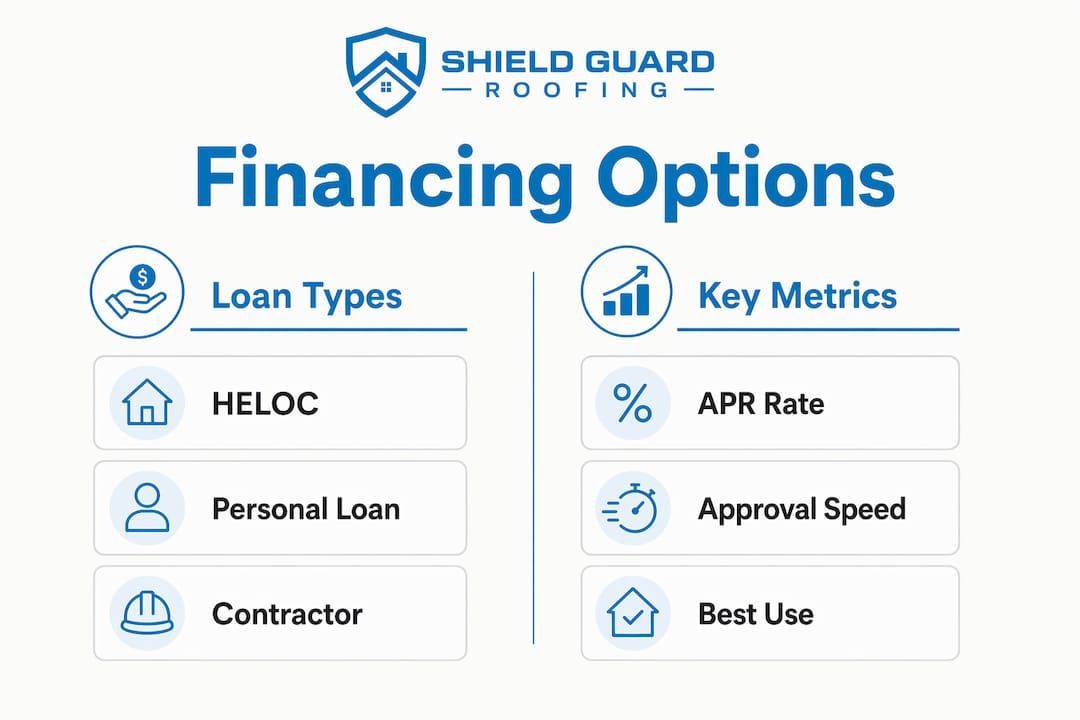
Credit score directly controls which rows of that table are available to you. Homeowners with scores above 700 typically qualify for HELOCs and the lower end of personal loan rates. Scores below 620 often push homeowners toward FHA Title I loans, contractor financing, or government programs. Knowing your score before you shop saves time and protects your credit from unnecessary hard inquiries.
For a project averaging $9,515, a personal loan at 12% APR over 5 years costs roughly $211 per month. The same amount on a HELOC at 8% over 10 years drops to about $115 per month. That difference adds up to thousands of dollars over the life of the loan.
Pro Tip: Pull your free credit report at AnnualCreditReport.com before applying for any roof loan. Disputing errors before you apply can raise your score enough to qualify for a lower rate.
If you are weighing repair versus full replacement, the repair vs. replacement guide for NorCal homeowners breaks down when each option makes financial sense.
What is the step-by-step process for applying for roof financing?
Getting financing in place before your contractor starts work protects you from delays and last-minute scrambles. Follow these steps in order.
- Check your credit score. Use a free service or your bank's credit monitoring tool. Know where you stand before you approach any lender.
- Estimate your project cost. Get at least two written quotes from licensed roofing contractors. Lenders want a specific number, not a rough guess.
- Verify your home equity. For HELOCs or home equity loans, you need a recent appraisal or a lender's automated valuation. Most lenders allow borrowing up to 85% of your home's appraised value minus what you owe.
- Choose your financing type. Match the option to your credit profile, urgency, and monthly budget using the rate table above.
- Submit your application. Personal loans and contractor financing can often be completed online in minutes. HELOC applications require more documentation and take longer to process.
- Review the terms carefully. Confirm the APR, loan term, monthly payment, and any prepayment penalties before signing.
Once financing is in place, managing it correctly matters just as much as choosing the right product.
- Set up automatic payments to avoid late fees.
- For deferred-interest offers, divide the total balance by the number of months in the promo period and pay that amount every month, not just the minimum. Retroactive interest charges apply to the full original balance if you miss the payoff deadline.
- Keep all loan documents, contractor invoices, and payment receipts in one folder. You may need them for insurance claims or tax purposes.
- Review your loan statement monthly to catch errors early.
Pro Tip: Treat a deferred-interest offer like a short-term loan with a hard deadline, not a free pass. Calculate the exact monthly payment needed to clear the balance before the promo expires and automate it from day one.
Contractor-managed financing platforms vary widely in terms and conditions. Always read the fine print before committing to any plan offered at the point of sale.
What government-backed programs help with roof replacement costs?
Two federal programs offer meaningful roof replacement cost assistance for homeowners who qualify. Both carry lower rates and more flexible terms than conventional loans.
USDA Rural Development Section 504
The USDA Section 504 program provides loans up to $40,000 at a fixed 1% interest rate with a 20-year repayment term. Grants up to $10,000 are available for very low-income homeowners aged 62 or older who cannot repay a loan. The program targets rural homeowners and covers repairs that remove health and safety hazards, which includes roof replacement. Eligibility requires income below 50% of the area median income for the loan program.
- Fixed 1% interest rate
- Loan terms up to 20 years
- Grants up to $10,000 (age 62+, cannot repay loan)
- Must be owner-occupied, rural property
- Income must be below 50% of area median income
FHA Title I property improvement loans
FHA Title I loans allow homeowners to borrow up to $7,500 without any collateral and up to $25,000 with collateral for property improvements including roof replacement. These loans are available through FHA-approved lenders and do not require home equity, making them accessible to homeowners who have not yet built significant equity. Credit requirements are more flexible than conventional loans, which makes this a practical path for homeowners rebuilding their credit.
Both programs take longer to process than personal loans or contractor financing. If your roof is actively leaking or structurally compromised, pursue a faster option first and then explore these programs for future improvements.
Key Takeaways
The right homeowner roof financing option depends on your credit score, available equity, and how quickly you need the roof replaced.
| Point | Details |
|---|---|
| HELOCs offer the lowest rates | Expect 7%–9% APR, but plan for a multi-week approval process. |
| Personal loans prioritize speed | Approval can happen the same day, though rates reach up to 36%. |
| Deferred-interest requires discipline | Pay the full balance before the promo ends or face retroactive interest on the original amount. |
| Government programs serve lower-income homeowners | USDA Section 504 and FHA Title I offer low rates and flexible credit requirements. |
| Average project cost is $9,515 | Use that benchmark to calculate monthly payments before you apply. |
What I have learned after years of watching homeowners finance roofs
The financing conversation almost always starts too late. A homeowner calls us after a storm, the roof is actively leaking, and they need a decision in 48 hours. At that point, their options narrow fast. A HELOC that would have saved them thousands in interest is off the table because approval takes weeks. They end up on a personal loan at 20% or a credit card, and they pay for that urgency for years.
The homeowners who come out ahead are the ones who treat roof financing like they treat car maintenance. They know a replacement is coming eventually, they check their equity and credit score while the roof still has a few years left, and they apply for a HELOC or explore government programs before there is any pressure. That preparation gives them the luxury of choosing the lowest-cost option.
Deferred-interest offers are genuinely useful, but only for homeowners who are honest with themselves about their cash flow. I have seen too many people sign up for a 12-month same-as-cash plan, make the minimum payments, and then get hit with retroactive interest on the full original balance in month 13. That is not a financing failure. It is a planning failure. If you cannot commit to paying the full balance before the promo expires, a fixed-rate personal loan is a safer choice even if the rate looks higher on paper.
My honest advice: if you qualify for the USDA Section 504 program or FHA Title I, use them. The rates and terms are better than almost anything the private market offers for homeowners in those income brackets. Most people do not know these programs exist until someone tells them.
— Cesar
Shieldguardroofing can help you find the right payment plan
Replacing a roof is one of the largest home repairs you will face. Shieldguardroofing makes that process easier for Northern California homeowners by combining over 75 years of combined roofing experience with access to flexible payment options.
Shieldguardroofing installs premium GAF and Brava roofing products backed by industry-leading warranties, so you are not just financing a roof. You are financing a long-term investment in your home. The team works with homeowners to identify financing paths that fit their budget, whether that means in-house payment plans or guidance on third-party loan options. Schedule a free inspection and cost estimate through the residential roofing services page, and get a clear number to bring to your lender before you apply. Shieldguardroofing serves homeowners and businesses across NorCal with honesty, integrity, and workmanship you can count on.
FAQ
What is the best financing option for a roof replacement?
The best option depends on your credit score and urgency. Homeowners with equity and time should use a HELOC at 7%–9% APR. Those who need faster access should consider a personal loan or contractor financing.
How much does a roof replacement typically cost?
The national average is about $9,515, with most projects falling between $5,867 and $13,212 depending on materials, labor, and roof size.
What happens if I miss the deadline on a deferred-interest roof loan?
Missing the payoff deadline triggers retroactive interest on the full original balance, not just the remaining amount. Always pay the full balance before the promotional period ends.
Can I get a roof loan with bad credit?
Yes. FHA Title I loans allow borrowing up to $7,500 without collateral and have more flexible credit requirements than conventional loans. The USDA Section 504 program is another option for qualifying rural homeowners.
How fast can I get financing for a roof replacement?
Personal loans offer same-day approval in many cases, and contractor financing can be approved on-site. HELOCs typically take several weeks from application to funding.
Recommended