What Is a Roofing Square? Your Complete Measurement Guide
What Is a Roofing Square? Your Complete Measurement Guide
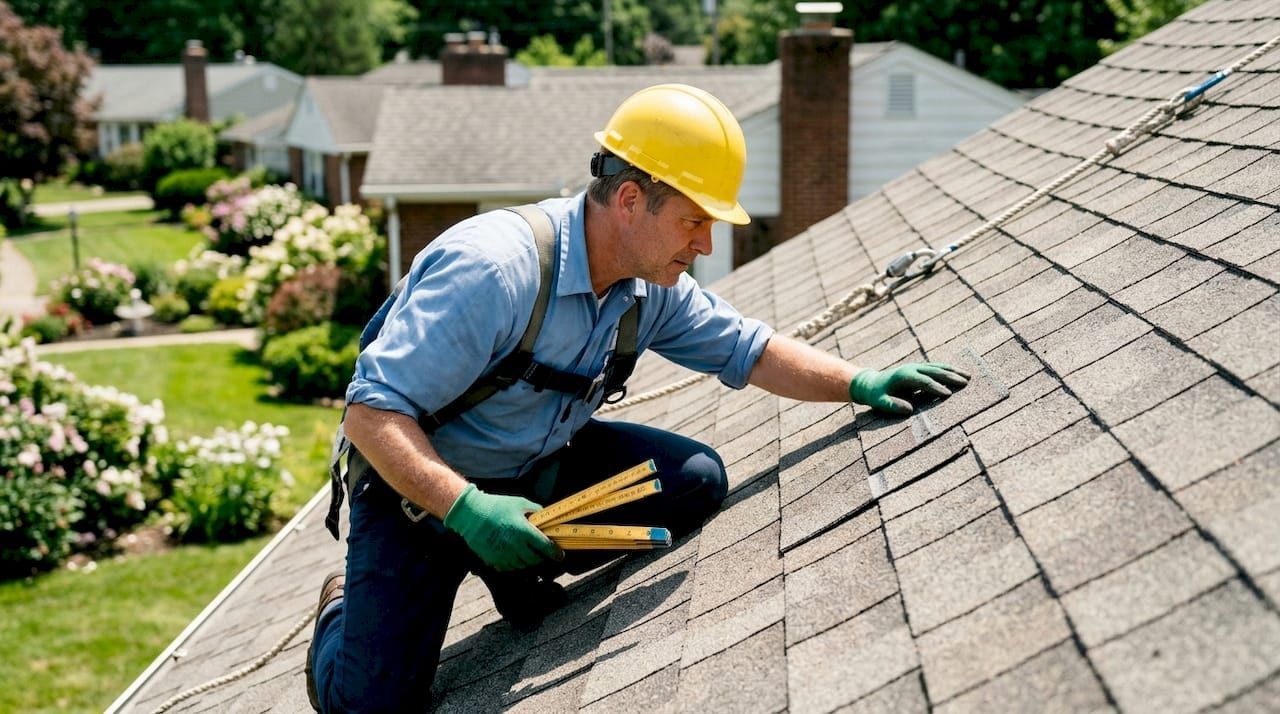
A roofing square is defined as exactly 100 square feet of roof surface, equivalent to a 10-foot by 10-foot section, and it serves as the industry standard for pricing, material ordering, and labor estimation. Every contractor quote you receive, every bundle of shingles on a pallet, and every insurance claim adjustment ties back to this single unit. Understanding the roofing square definition before you talk to a contractor puts you in control of your project and your budget. Most American homes range from 15 to 30 squares, meaning even a small miscalculation can cost you hundreds of dollars in wasted materials or emergency reorders.
What is a roofing square and how is roof area calculated?
Calculating roofing squares starts with one fact most homeowners miss: your roof is not flat. The slope of your roof adds real surface area beyond what you see from the ground. A 2,000 square foot home footprint does not equal 2,000 square feet of roofing material. The actual roof surface area is always larger once you account for pitch.
The roofing square formula works in three steps:
- Measure your home's footprint. Multiply the length by the width of your home at ground level. A 40-foot by 50-foot home gives you a 2,000 square foot footprint.
- Apply the pitch multiplier. Pitch multipliers convert your flat footprint into actual sloped roof area. A 4/12 pitch uses a multiplier of 1.054, a 6/12 pitch uses 1.118, and a steep 12/12 pitch uses 1.414.
- Divide by 100. The result gives you your net roofing squares. A 2,000 square foot footprint with a 6/12 pitch equals 2,236 square feet of roof surface, or roughly 22.4 squares.
The pitch multiplier is the step most DIY estimates skip entirely. A steep 12/12 pitch adds 41% more surface area compared to a flat roof. That difference translates directly into more shingles, more underlayment, and more labor hours.
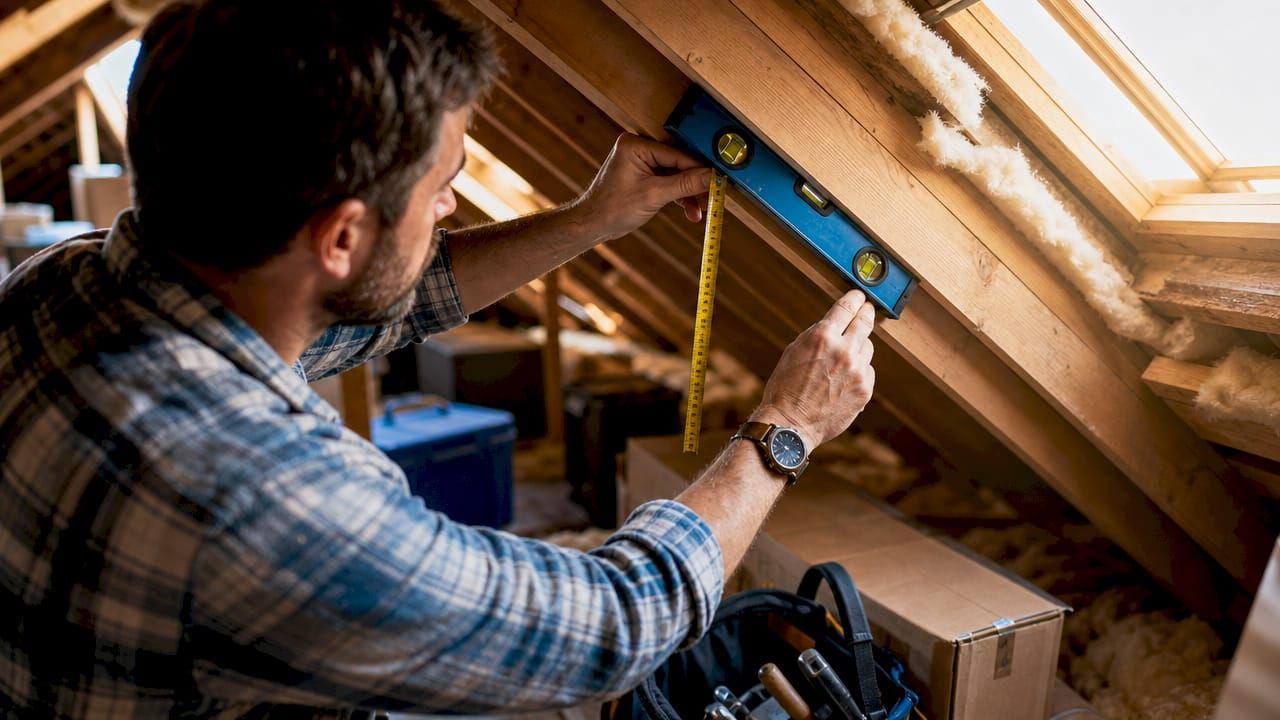
Pro Tip: Measure your roof pitch from inside the attic using a level and a tape measure. Hold the level horizontally, measure 12 inches along it from the rafter, then measure straight up to the rafter. That vertical number is your pitch.
Roof pitch also affects how safely and quickly a crew can work, which feeds into labor pricing per square. A 4/12 pitch is considered walkable. Anything above 7/12 typically requires additional safety equipment and adds to your cost per square.
What is the difference between net squares and project squares?
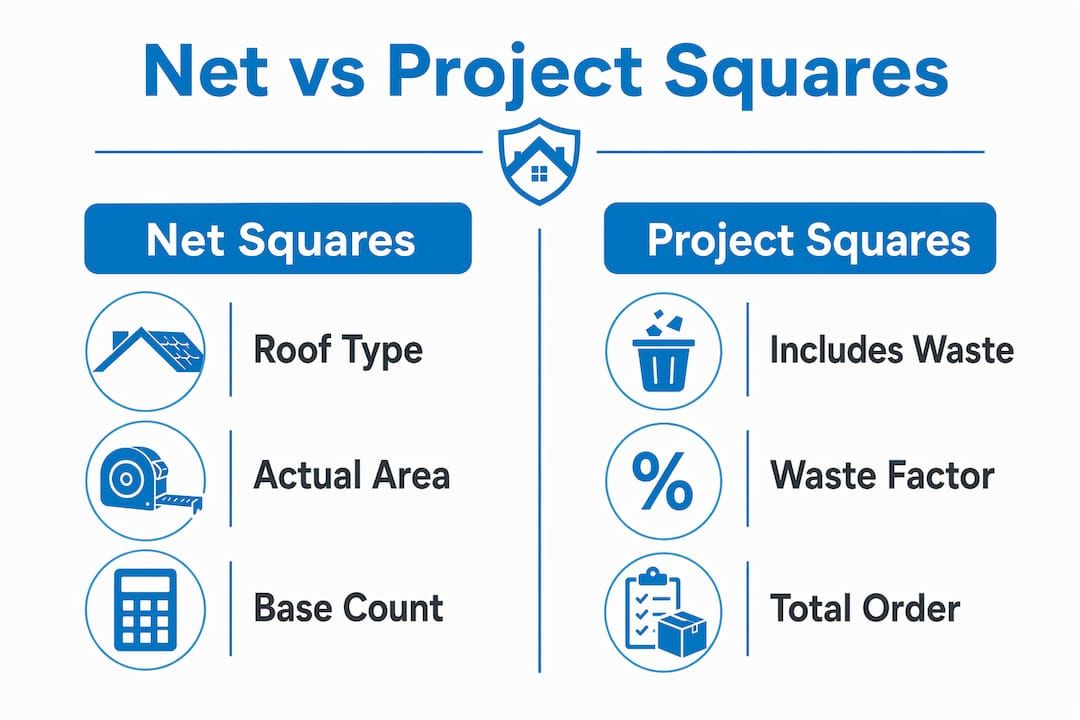
Net roofing squares represent the actual measured surface area of your roof divided by 100. Project squares are larger. They include a waste factor added on top of the net count to cover material lost during cutting and fitting.
Waste happens at every hip, valley, dormer, and roof edge. When a roofer cuts a shingle to fit around a chimney or along a hip line, the offcut goes in the dumpster, not back on the roof. Waste factors vary by roof complexity:
- Simple gable roof: Add 5% waste. A 20-square gable roof needs about 21 squares ordered.
- Moderately complex roof: Add 10% waste for roofs with one or two dormers or a single valley.
- Highly complex roof: Add 10%–15% waste for roofs with multiple hips, valleys, and dormers. A 20-square complex roof may require 21 to 23 squares ordered to avoid running short.
| Roof type | Net squares | Waste factor | Squares to order |
|---|---|---|---|
| Simple gable | 20 | 5% | 21 |
| Moderate complexity | 20 | 10% | 22 |
| High complexity | 20 | 15% | 23 |
Under-ordering is the more painful mistake. Running out of shingles mid-job means delays, a second delivery charge, and the risk that the new batch comes from a different dye lot with a slightly different color. Over-ordering by one square wastes money but keeps the job moving.
Pro Tip: Always ask your contractor to show you the waste factor they used in your estimate. A reputable contractor will explain it clearly. If they cannot, that is a red flag worth taking seriously.
How many bundles make up a square, and why does it matter?
A roofing square and a bundle of shingles are not the same thing. Standard architectural shingles require 3 bundles to cover one square. Specialty products, including Class 4 impact-rated shingles, often require 4 bundles per square.
This distinction matters the moment you walk into a supply house or review a contractor's material list. Here is how bundle counts break down by common shingle type:
- Standard 3-tab shingles: 3 bundles per square
- Architectural (dimensional) shingles: 3 bundles per square
- Class 4 impact-rated shingles: 4 bundles per square
- Specialty or designer shingles: Verify on the packaging. Coverage per bundle varies by manufacturer.
GAF, one of the manufacturers Shieldguardroofing works with, lists bundle coverage clearly on product packaging. Never assume. A 22-square project using standard architectural shingles needs 66 bundles. The same project using Class 4 impact-rated shingles needs 88 bundles. That is a meaningful cost difference that changes your budget before a single nail is driven.
| Shingle type | Bundles per square | Bundles for 22 squares |
|---|---|---|
| Standard 3-tab | 3 | 66 |
| Architectural | 3 | 66 |
| Class 4 impact-rated | 4 | 88 |
| Designer/specialty | Verify on packaging | Varies |
Always verify bundle coverage on the product label before placing your order. Packaging is the authoritative source, not a general rule of thumb.
Common mistakes when using roofing squares for estimates
The most expensive roofing mistakes start with measurement errors, not installation errors. Catching them before the job starts saves real money.
- Using footprint without pitch adjustment. Steeper roofs can add several squares of material beyond what a flat footprint suggests. A homeowner who quotes their contractor a "2,000 square foot roof" based on their home's floor plan is giving inaccurate data. The contractor should always verify with a pitch-adjusted calculation.
- Skipping the waste factor. Ordering net squares without adding waste is the fastest way to run short on materials. Even a simple gable roof needs a 5% buffer to account for starter strips, ridge caps, and edge cuts.
- Ignoring roof complexity. Dormers, skylights, chimneys, and multiple valleys each add waste. A roof that looks simple from the street may have significant complexity from above.
- Relying on satellite measurements alone. Satellite and drone measurements are accurate for footprint but may not capture every architectural detail. For complex roofs, an on-site measurement by an experienced contractor is the most reliable method.
- Not verifying the contractor's square count. You can do a rough check yourself. Measure your home's footprint, apply the pitch multiplier, divide by 100, and add your waste factor. If your contractor's number is more than 10% different, ask them to walk you through their calculation.
Pro Tip: For a quick DIY check, use your home's square footage from your property records as your footprint starting point. Multiply by your pitch factor, divide by 100, and add 10% for waste. This gives you a ballpark to compare against contractor quotes.
You can also review common reasons roof repairs fail to understand how measurement errors early in a project can lead to problems years later.
How to apply roofing square knowledge to your project budget
Knowing your square count turns a vague roofing project into a concrete budget. Here is how to use that number from start to finish.
- Calculate your project squares. Start with your net squares from the pitch-adjusted formula, then add your waste factor based on roof complexity.
- Estimate material costs. Roofing materials are priced per square. Multiply your project square count by the cost per square for your chosen material. GAF architectural shingles and Brava composite products, both carried by Shieldguardroofing, have different price points per square, so confirm current pricing with your supplier.
- Estimate labor costs. Labor is also quoted per square. A steeper pitch increases the labor rate per square because the work is slower and requires more safety equipment.
- Use your square count for insurance claims. Accurate square counts are the foundation of any storm damage claim. Adjusters use the same roofing square standard to calculate replacement costs. An inaccurate count in either direction creates problems with your settlement.
- Communicate clearly with your contractor. When you request quotes from multiple contractors, ask each one to provide their square count and waste factor in writing. This makes quotes directly comparable and eliminates the guesswork from pricing differences.
Understanding how residential roof replacement works gives you the full picture of how square counts feed into every stage of a roofing project, from the initial estimate through final inspection.
Key Takeaways
A roofing square equals 100 square feet of actual roof surface, and every accurate estimate, material order, and insurance claim depends on calculating that number correctly with pitch and waste factors included.
| Point | Details |
|---|---|
| Roofing square definition | One square equals 100 square feet, the industry standard for pricing and ordering. |
| Pitch multipliers matter | Apply pitch factors (1.054 to 1.414) to convert footprint into actual roof area. |
| Net vs. project squares | Always add 5%–15% waste to net squares before ordering materials. |
| Bundles per square | Standard architectural shingles need 3 bundles; Class 4 impact-rated need 4. |
| Verify contractor estimates | Ask for the square count and waste factor in writing before approving any quote. |
Why roofing squares changed how I think about every estimate
I have reviewed hundreds of roofing estimates over the years, and the single most common source of budget surprises is not labor costs or material prices. It is a misunderstood square count. Homeowners come to us after getting wildly different quotes from different contractors, and almost every time, the gap traces back to one contractor using a flat footprint and another using a pitch-adjusted number with a proper waste factor.
The roofing square is not just a unit of measurement. It is a communication tool. When both you and your contractor are working from the same square count, the entire conversation changes. You can compare quotes line by line. You can verify material quantities. You can catch errors before they become expensive.
My honest advice: do not skip the pitch multiplier step, even for a rough estimate. A 6/12 pitch adds more than 11% to your material needs compared to a flat roof. On a 25-square project, that is nearly 3 extra squares of shingles. At current material prices, that is a real number that affects your budget.
For complex roofs with multiple hips, valleys, and dormers, I always recommend a professional on-site measurement rather than relying on satellite data alone. The satellite image shows the footprint well, but it cannot always capture every architectural detail that drives waste. Getting that number right at the start protects you from shortages, delays, and the frustration of a second material delivery.
— Cesar
Shieldguardroofing brings accurate measurement to every Sacramento roof
Knowing your square count is the first step. Getting it measured correctly is what protects your investment.
Shieldguardroofing serves homeowners across Northern California with over 75 combined years of roofing experience. Every estimate starts with a precise, pitch-adjusted measurement so you know exactly what your project requires before any work begins. The team works with GAF, GAF Energy, and Brava Roofing products, giving you access to materials priced and packaged by the square for straightforward ordering. Whether you need a full replacement or targeted repairs, residential roofing in Sacramento from Shieldguardroofing means you get a clear square count, a transparent waste factor, and a quote you can actually compare. Contact Shieldguardroofing today for a free estimate.
FAQ
What does one roofing square equal in square feet?
One roofing square equals exactly 100 square feet of roof surface area, equivalent to a 10-foot by 10-foot section. This is the universal standard used by contractors, suppliers, and insurance adjusters across the United States.
How do I calculate roofing squares for my home?
Multiply your home's footprint length by width, then multiply by the appropriate pitch factor (for example, 1.118 for a 6/12 pitch), and divide by 100. Add a waste factor of 5%–15% depending on roof complexity to get your final project square count.
How many bundles of shingles do I need per square?
Standard architectural shingles require 3 bundles per roofing square. Class 4 impact-rated and specialty shingles may require 4 bundles per square, so always verify the coverage listed on the product packaging before ordering.
Why does roof pitch affect the number of squares?
Roof pitch increases the actual surface area of your roof beyond its flat footprint. A 12/12 pitch uses a multiplier of 1.414, meaning a roof with that slope has 41% more surface area than its ground footprint suggests, which directly increases material needs.
What is the difference between net squares and project squares?
Net squares represent the actual measured roof area divided by 100. Project squares add a waste factor of 5%–15% to account for material lost during cutting around hips, valleys, edges, and other roof features, and this is the number you use when ordering materials.
Recommended