What Is a Roofing Bond? A Guide for NorCal Owners
What Is a Roofing Bond? A Guide for NorCal Owners

A roofing bond is a legally binding surety bond that guarantees a roofing contractor will meet their contractual and regulatory obligations, with financial recourse available to you if they fail. The industry term is "surety bond," and you will hear both phrases used interchangeably in Northern California contracting. This three-party agreement involves the Principal (the contractor), the Obligee (you, the project owner, or a regulatory agency), and the Surety (the bonding company that backs the guarantee). Understanding how this works protects your investment before a single shingle goes up.
What is a roofing bond and how does it protect you?
A roofing surety bond is a financial guarantee, not an insurance policy. Insurance protects contractors from liability; a surety bond protects you, the project owner, by guaranteeing financial recourse if the contractor defaults or violates their obligations. That distinction matters enormously when something goes wrong on your roof.
Think of it like a co-signer on a loan. The surety company stands behind the contractor's promises. If the contractor walks off the job, fails to pay subcontractors, or violates licensing laws, you have a formal financial remedy through the bond rather than a costly lawsuit.

The three-party bond structure places the contractor's financial credibility on the line. Before a surety company issues a bond, it vets the contractor's financial history, credit, and work record. That vetting process alone filters out unreliable operators before they ever reach your property.
For Northern California homeowners and business owners, this matters because the region's contractor licensing requirements tie directly to bonding. A contractor who cannot get bonded is signaling a financial or compliance problem you do not want to inherit.
What types of roofing bonds exist?
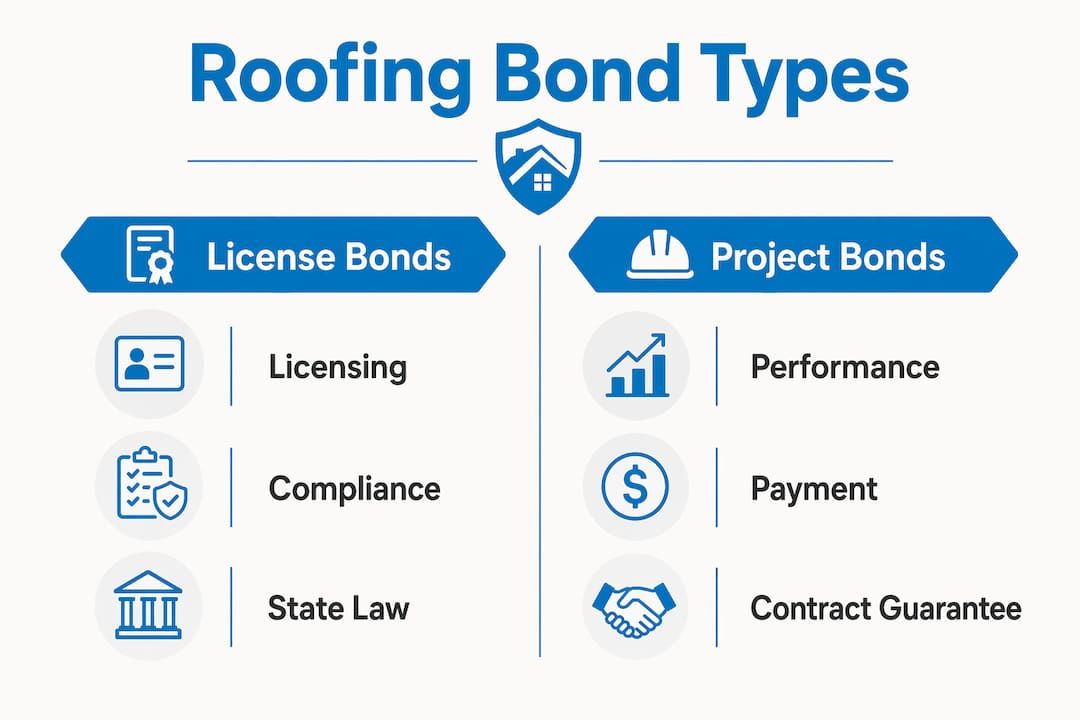
Three main bond types cover different risks in roofing projects. Each one addresses a specific obligation, and knowing the difference helps you ask the right questions before signing a contract.
License bonds are the most common. They guarantee a contractor complies with state and local licensing laws. California requires roofing contractors to carry a license bond as a condition of their contractor's license. Without it, they cannot legally operate.
Performance bonds guarantee the contractor completes the project according to the contract terms. These are project-specific and scale with the contract value. If a contractor abandons your re-roofing job halfway through, the performance bond funds the cost to bring in another contractor to finish.
Payment bonds protect subcontractors and material suppliers. If your general contractor fails to pay the crew or the supplier who delivered your GAF shingles, the payment bond covers those obligations. This prevents mechanics' liens from attaching to your property.
| Bond type | What it covers | Typical bond amount |
|---|---|---|
| License bond | Regulatory and licensing compliance | $5,000–$25,000 depending on state |
| Performance bond | Project completion per contract terms | Scales with contract value |
| Payment bond | Subcontractor and supplier payments | Scales with contract value |
Performance and payment bonds are most common on large commercial jobs and government projects. License bonds apply to virtually every licensed roofing contractor in California.
How does a roofing bond work when something goes wrong?
The claims process is straightforward. You file a claim with the surety company, documenting how the contractor failed to meet their obligations. The surety investigates the claim, and if it is valid, they pay you up to the bond's face value.
Here is the part most people do not expect: the surety then recovers that payment from the contractor. A surety bond operates more like a line of credit than an insurance payout. The contractor's assets serve as collateral, and the surety company pursues reimbursement after settling your claim. This structure keeps contractors financially accountable in a way that insurance alone does not.
Common claim scenarios include:
- Incomplete work. The contractor stops mid-project and does not return. The bond funds completion costs.
- Regulatory violations. The contractor fails to pull required permits or violates building codes. The license bond covers resulting fines or remediation costs.
- Non-payment to suppliers. Materials were delivered but the contractor never paid the supplier. The payment bond covers the outstanding balance.
- Defective workmanship. In some cases, bonds cover costs to correct work that does not meet the contract specifications.
Pro Tip: Always request a copy of the bond certificate before work begins. The certificate lists the bond amount, the surety company's name, and the bond's expiration date. Verify the bond is active, not expired.
The bond amount sets the ceiling on your financial recovery. A $10,000 license bond will not fully cover a $50,000 commercial roofing loss. For large projects, ask specifically about performance bonds scaled to your contract value.
What are roofing bond requirements in Northern California?
California's Contractors State License Board (CSLB) requires all licensed contractors, including roofing contractors, to carry a contractor's license bond. The CSLB sets the bond amount, and contractors must maintain it continuously to keep their license active.
Typical license bond amounts across states range from $5,000 to $25,000, with the actual cost to the contractor determined largely by their credit score. A contractor with strong credit might pay as little as $50 to $250 annually for a basic license bond. A contractor with poor credit pays significantly more, which is itself a signal worth noting.
Key Northern California bond requirements to know:
- CSLB license bond: Required for all licensed contractors in California. Verify the bond is current through the CSLB's online license lookup tool.
- Project-specific bonds: Large commercial or government contracts in Sacramento and surrounding counties often require performance and payment bonds beyond the base license bond.
- Public projects: Bonding is mandatory on government jobs because contractors cannot file mechanics' liens on public property. The bond is the primary financial remedy available.
- Workers' compensation bond: Some California contracts require this in addition to standard surety bonds.
For commercial projects, review your contract carefully. A commercial roof replacement on a large Sacramento property will almost certainly require performance and payment bonds beyond the contractor's base license bond.
What are the benefits of hiring a bonded roofing contractor?
Hiring a bonded contractor gives you financial protection that licensing and insurance alone do not provide. Bonded contractors have been vetted by a surety underwriter who reviewed their financial stability, credit history, and work record. That scrutiny filters out contractors who cannot meet basic financial accountability standards.
The concrete benefits for Northern California homeowners and business owners include:
- Financial recourse without litigation. You file a bond claim rather than suing the contractor, which is faster and less expensive.
- Verified financial stability. The surety's vetting process confirms the contractor has a track record worth backing.
- Protection beyond insurance. Bonds protect project owners in ways that contractor liability insurance does not, particularly for regulatory violations and non-payment issues.
- Access to government and large commercial projects. Bonded contractors can bid on public projects where unbonded contractors are disqualified.
- Reduced lien risk. Payment bonds protect your property from mechanics' liens filed by unpaid subcontractors or suppliers.
Pro Tip: When evaluating contractors, check the contractor qualities checklist to confirm bonding, licensing, and insurance are all current before signing anything.
Bonding is not a guarantee of perfect work. It is a financial safety net that gives you a clear path to recovery if things go wrong. That peace of mind is worth prioritizing on any roofing project.
How do you verify a contractor's bond status?
Verification takes less than five minutes and protects you from significant financial risk. Start with the California Contractors State License Board's online license lookup at cslb.ca.gov. Enter the contractor's license number and confirm the bond status shows as active.
Beyond the CSLB lookup, ask the contractor directly for:
- A copy of their bond certificate showing the surety company, bond amount, and expiration date
- Proof of general liability insurance and workers' compensation coverage
- The surety company's contact information so you can verify the bond independently
Red flags that signal bonding problems include a contractor who cannot produce a bond certificate on request, a bond that expired within the last year, a surety company you cannot verify through a quick search, and a contractor who deflects questions about bonding with vague reassurances.
Unbonded contractors are not just a financial risk. In California, hiring an unlicensed and unbonded contractor can expose you to liability for injuries on your property and void your homeowner's insurance coverage for the work performed. The verification step is non-negotiable.
Key Takeaways
A roofing surety bond is the single most important financial protection tool available to Northern California property owners when hiring a roofing contractor.
| Point | Details |
|---|---|
| Bond definition | A surety bond is a three-party guarantee protecting project owners, not contractors. |
| Three bond types | License, performance, and payment bonds each cover different obligations and risks. |
| Claims process | File with the surety company; they pay valid claims and recover costs from the contractor. |
| California requirements | The CSLB requires all licensed roofing contractors to carry an active license bond. |
| Verification step | Confirm bond status at cslb.ca.gov before signing any roofing contract. |
Why bonding is the first question I ask about any contractor
I have spent years watching Northern California property owners make the same mistake: they check a contractor's license number and stop there. Licensing and bonding are related, but they are not the same thing. A license tells you the contractor passed a test. A bond tells you a financial institution reviewed their business and decided to back them.
The surety underwriting process is genuinely rigorous. Contractors with shaky finances, a history of claims, or poor credit simply cannot get bonded at reasonable rates. That market pressure creates a natural filter that benefits you as a client. When a contractor hands you a current bond certificate without hesitation, that document represents a level of vetting that no license exam replicates.
My honest advice: treat bonding as a baseline requirement, not a bonus. On any residential or commercial roofing project in Northern California, ask for the bond certificate before you ask for the quote. If a contractor cannot produce it, move on. The financial exposure from an unbonded contractor on a significant roofing job far outweighs any savings from a lower bid.
— Cesar
Shieldguardroofing: fully bonded roofing services in Northern California
Shieldguardroofing is fully bonded, licensed, and insured, serving homeowners and business owners across Northern California with over 75 combined years of roofing experience. Every project, from a single-family home in Sacramento to a large commercial property, carries the financial protections that bonding provides.
Whether you need residential roofing in Sacramento or a full commercial roofing solution, Shieldguardroofing brings GAF-certified materials, industry-leading warranties, and the accountability that comes with proper bonding. You get a contractor who has been vetted, not just licensed. Contact Shieldguardroofing today to request your bond certificate, get a project estimate, and start your roofing project with complete confidence.
FAQ
What is the roofing bond definition in simple terms?
A roofing bond is a surety bond that guarantees a roofing contractor will fulfill their contractual and legal obligations, with the bonding company providing financial compensation to the project owner if the contractor fails.
How does a roofing bond work when I file a claim?
You submit a claim to the surety company with documentation of the contractor's failure. The surety investigates and pays valid claims up to the bond amount, then recovers that payment directly from the contractor.
What are the roofing bond requirements in California?
The California Contractors State License Board requires all licensed roofing contractors to carry an active license bond. Large commercial and government projects typically require additional performance and payment bonds scaled to the contract value.
What are the main benefits of a roofing bond for property owners?
A roofing bond gives you financial recourse without litigation, confirms the contractor has passed surety underwriting, and protects your property from mechanics' liens filed by unpaid subcontractors or suppliers.
How do I verify a contractor's bond status in Northern California?
Use the CSLB's online license lookup at cslb.ca.gov to confirm the bond is active, and request a bond certificate directly from the contractor showing the surety company name, bond amount, and expiration date.
Recommended