Commercial Roofing Contractor Qualities Checklist for 2026
Commercial Roofing Contractor Qualities Checklist for 2026
A qualified commercial roofing contractor is defined by verified licensing, adequate insurance, documented experience, and manufacturer certifications. These are not optional extras. They are the minimum standards that separate contractors who protect your property from those who put it at risk. Using a structured commercial roofing contractor qualities checklist before you sign any contract gives you a clear framework for making a decision you will not regret. This guide covers every criterion you need, backed by industry standards including OSHA fall protection requirements, GAF Master Elite certification benchmarks, and the $1 million liability coverage threshold.
1. What licensing and insurance qualifications should a contractor hold?
Licensing is the first filter on any checklist for roofing contractor vetting. State-issued roofing licenses can expire or be revoked, so always verify directly through your state's official contractor licensing board rather than trusting a copy handed to you at a meeting. License verification is a non-negotiable first step, not a formality.
Insurance requirements are equally firm. Commercial contractors need at least $1 million in general liability coverage, plus workers' compensation in 49 states (Texas allows employers to opt out). Without these, your property and your business absorb the financial risk of any on-site accident or damage.
Key documents to request before any work begins:
- Current state roofing license with commercial endorsement
- Certificate of general liability insurance ($1 million minimum)
- Workers' compensation certificate
- Proof of any subcontractor coverage
Pro Tip: Ask the contractor for their OSHA 300A summary form. This annual safety report shows recorded workplace injuries and illnesses, giving you a factual picture of how they manage job-site safety.
2. Why does commercial roofing experience matter so much?
Commercial roofing is not residential roofing scaled up. Flat membranes, drainage systems, rooftop equipment penetrations, and load calculations require a different skill set entirely. Contractors need 3–5 years of documented commercial experience to handle these systems competently. Ask for a project list with building types, square footage, and contact references.
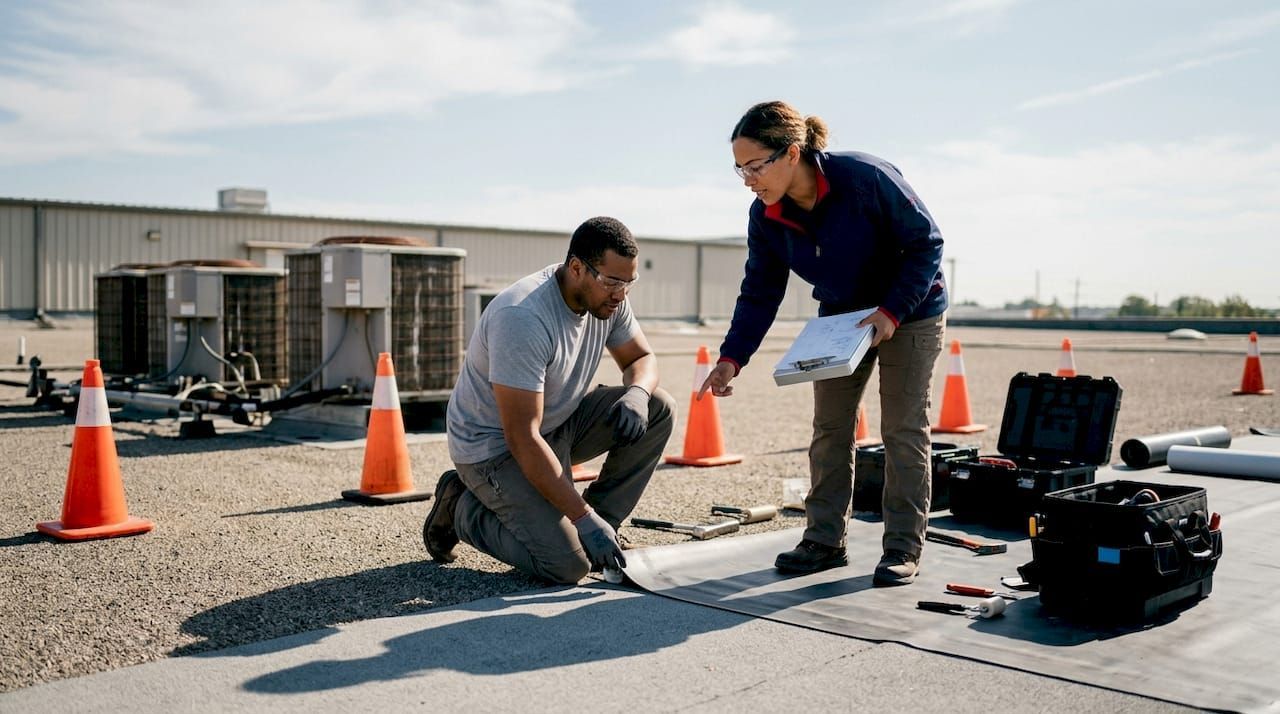
Experience also means familiarity with the right materials for each building type. Roof material choice should reflect the building's purpose. A restaurant kitchen exhaust system demands chemical-resistant PVC membrane. A warehouse benefits from durable modified bitumen rather than a cheaper single-ply option. A contractor without commercial experience will not know the difference until it is too late.
Request at least three commercial references from projects completed in the last two years. Call them. Ask specifically about project timelines, communication quality, and whether the finished roof performed as promised.
3. How do manufacturer certifications protect your investment?
Manufacturer certifications are the clearest signal that a contractor has been formally trained and audited on specific roofing systems. Fewer than 3% of roofing contractors hold elite status designations like GAF Master Elite. That rarity matters because it reflects exhaustive training requirements, ongoing audits, and a proven installation track record.
The financial benefit is direct. Certified contractors can offer extended manufacturer warranties covering both labor and materials with no dollar limits. These warranties can run 20–30 years and sometimes longer. A non-certified contractor can only offer their own workmanship warranty, which is worth nothing if the company closes in five years.
Certifications to look for include:
- GAF Master Elite (available through Shieldguardroofing)
- Manufacturer-specific system certifications for TPO, PVC, and modified bitumen
- Evidence of ongoing training and product knowledge updates
Pro Tip: Always ask which specific systems the contractor is certified to install. A GAF certification does not automatically cover every GAF product line. Confirm the match between your chosen material and their certified expertise.
4. What warranties and safety records reveal about contractor quality
Warranties tell you two things: how confident the manufacturer is in the installation, and how confident the contractor is in their own work. Workmanship warranties typically run 2–10 years and depend entirely on the contractor still being in business when you need to make a claim. Manufacturer warranties run 20–30 years and offer far stronger financial protection, but only certified contractors can issue them.
A workmanship warranty is only as strong as the contractor behind it. If the company folds in year three, your two-year warranty disappears with it. The manufacturer warranty backed by certified installation is the only guarantee with real staying power.
Safety records are equally revealing. The Experience Modification Rate (EMR) is the most useful metric most property managers never ask about. An EMR below 1.0 signals a safer operation with fewer claims. An EMR above 1.0 indicates higher job-site risk. Request this number directly and verify it with the contractor's insurance carrier.
| Warranty Type | Duration | Who Backs It | Key Risk |
|---|---|---|---|
| Workmanship warranty | 2–10 years | Contractor | Contractor goes out of business |
| Manufacturer warranty | 20–30 years | Manufacturer | Requires certified installation |
| System warranty | Up to 50 years | Manufacturer | Requires elite certification tier |
Federal OSHA standards require fall protection for all roofing work at heights over 6 feet. Any contractor who cannot document compliance with this standard is a liability risk you should not accept.
5. What role do communication and maintenance programs play?
A contractor who communicates clearly before the project starts will manage the project better when problems arise. Evaluate responsiveness during the bidding phase. If emails go unanswered for days or proposals arrive without detail, that pattern will repeat during construction.
Preventive maintenance programs extend roof lifespan and improve your return on investment significantly. Facility managers who partner with contractors offering scheduled inspections and planned repairs avoid the far more expensive cycle of reactive emergency fixes. Think of it like oil changes for your vehicle. Small, regular investments prevent major breakdowns.
The qualities of roofing contractors who offer maintenance programs include:
- Scheduled biannual inspections with written reports
- Priority response for storm damage or leak calls
- Documented repair history for warranty compliance
- A single point of contact for all service needs
Shieldguardroofing offers commercial roof maintenance programs designed specifically for Northern California commercial properties. Pairing installation with a maintenance plan is the most reliable way to protect a long-term roofing investment.
Pro Tip: Treat your roofing contractor like a long-term business partner, not a one-time vendor. Contractors who know your building's history respond faster, diagnose problems more accurately, and catch issues before they become expensive.
6. How should you evaluate cost versus value in contractor bids?
The lowest bid is rarely the best value. Low initial bids often reflect cheaper fasteners, thinner insulation, or skipped steps that violate energy codes like the International Energy Conservation Code (IECC). These shortcuts void manufacturer warranties and can trigger code violations that cost far more to correct than the original savings.
Evaluate bids by comparing what is included, not just the total price. Ask each contractor to specify insulation R-value, membrane thickness, fastener type, and warranty terms in writing. A bid that omits these details is hiding something.
| Cost-Cutting Shortcut | Quality Impact |
|---|---|
| Substandard insulation thickness | Fails IECC energy codes, voids warranty |
| Cheaper fasteners | Reduces wind uplift resistance |
| Non-certified installation | Eliminates manufacturer warranty eligibility |
| Skipping underlayment layers | Reduces system lifespan significantly |
Prioritize long-term performance over initial savings. A roof that fails in year seven costs far more than the difference between a quality bid and a cut-rate one. Review the commercial roofing materials comparison to understand what specifications you should be asking for before you accept any proposal.
Key Takeaways
Selecting a commercial roofing contractor requires verifying licensing, insurance, certifications, safety records, and warranty terms before any work begins.
| Point | Details |
|---|---|
| Licensing and insurance | Confirm $1 million liability coverage and workers' comp before signing anything. |
| Manufacturer certifications | Fewer than 3% of contractors hold elite certifications; only they can issue extended warranties. |
| EMR safety metric | Request an EMR score and reject contractors above 1.0 as a higher-risk operation. |
| Warranty type matters | Manufacturer warranties (20–30 years) outlast workmanship warranties if the contractor closes. |
| Cost vs. value | Low bids often skip insulation or use cheap fasteners, voiding warranties and violating codes. |
What I've learned from watching property managers hire the wrong contractor
After years working alongside commercial property owners across Northern California, the pattern I see most often is this: the hiring decision gets made on price, and the pain shows up 18 months later. A membrane lifts at a seam. A drain backs up. A warranty claim gets denied because the installation was never certified. By then, the low-bid contractor is unreachable.
The checklist approach works because it removes emotion from the decision. When you ask every contractor the same questions, the answers reveal who is prepared and who is not. A contractor who cannot produce an EMR score, a current license certificate, and a manufacturer certification letter in the same week is not organized enough to manage your project.
The detail most property managers overlook is the difference between a workmanship warranty and a manufacturer warranty. Building owners often confuse these two, assuming any written warranty provides equal protection. The manufacturer warranty backed by certified installation is the only one that holds up when the contractor is no longer in business. That distinction alone is worth the time it takes to verify certifications before you commit.
My honest advice: spend more time on the vetting process than you think you need to. The right contractor will welcome your questions. The wrong one will rush you past them.
— Cesar
Shieldguardroofing: built to meet every item on this checklist
Shieldguardroofing is a family-owned roofing company with over 75 years of combined experience serving Northern California businesses and property managers. The team holds verified licensing, carries full general liability and workers' compensation coverage, and installs GAF and GAF Energy systems as a certified contractor.
Every commercial project comes with access to manufacturer-backed warranties and the option to enroll in a preventive maintenance program that keeps your roof performing year after year. If you are ready to work with a contractor who checks every box on your list, visit the commercial roofing services page to review credentials and request a detailed proposal. For repair needs, Shieldguardroofing also handles commercial roof repairs with the same standards applied to new installations.
FAQ
What insurance does a commercial roofing contractor need?
A commercial roofing contractor needs at least $1 million in general liability insurance and workers' compensation coverage. Workers' comp is required in 49 states, with Texas as the only exception.
How do I verify a roofing contractor's license?
Check your state's official contractor licensing board directly using the contractor's license number. Licenses can expire or be revoked, so never rely solely on a copy the contractor provides.
What is an EMR score and why does it matter?
EMR stands for Experience Modification Rate, a metric that measures a contractor's workplace safety history. An EMR below 1.0 indicates a safer operation; above 1.0 signals higher job-site risk.
What is the difference between a workmanship warranty and a manufacturer warranty?
A workmanship warranty (2–10 years) is backed by the contractor and becomes worthless if the company closes. A manufacturer warranty (20–30 years) is backed by the product maker and requires certified installation to activate.
Why do manufacturer certifications like GAF Master Elite matter?
Fewer than 3% of contractors hold elite manufacturer certifications, which require rigorous training and audits. Only certified contractors can issue extended system warranties covering both labor and materials without dollar limits.
Recommended